
Equality and Diversity
IYV Equality and Diversity Policy
Inspiring Young Voices (IYV) is committed to providing a working environment in which employees and volunteers are able to realise their full potential and to contribute to the achievement of the aims of IYV irrespective of these “protected characteristics”. This is a key employment value to which all employees are expected to give their support.
IYV is also committed to providing participation and volunteering opportunities to children and young people to enable them to realise their full potential to contribute to the work of IYV and its aim of improving services for children and young people with additional support needs.
This Equality and Diversity Policy aims to ensure that the terms of the Equality Act 2010 are fully complied with.
The Equality Act 2010 has codified and amended existing discrimination legislation provides various safeguards for the following attributes, which are referred to as ‘Protected Characteristics’. These are:
- Age
- Disability
- Gender reassignment
- Marriage and civil partnership
- Pregnancy and maternity
- Race
- Religion or belief
- Sexual orientation
The Act provides for specific forms of ‘Prohibited Conduct’ by which these characteristics are protected.
Scope
This policy applies to all employees, volunteers (including Charity Trustees) and participants.
IYV Responsibilities
IYV is committed to identifying and eliminating discriminatory practices, procedures and attitudes throughout the organisation. IYV expects employees, volunteers and participants to support this commitment and to assist in its realisation in all possible ways.
IYV aims to ensure that no employee, job applicant, volunteer or participant is discriminated against, either directly or indirectly, on the grounds of age, gender, race colour, nationality, ethnic or racial origin, marital status, religious belief, political opinion or affiliation or disability.
This commitment applies to all aspects of IYV operation:
- Employee recruitment and selection, including advertisements, job descriptions, interview and selection procedures
- Promotion and career development opportunities
- Training
- Grievance handling and the application of disciplinary procedures
- Selection for redundancy
- Terms and conditions of employment, and access to employment related benefits and facilities
- Volunteer recruitment and support
- Work of Board of Trustees
- Development of children and young people’s participation
Trustee Responsibility
The Board of Trustees are responsible for the equality of opportunity. Equality of opportunity is part of the larger management responsibility of ensuring that the employment environment provides employees with motivation to do a good job. Equality of opportunity is also part of the development of volunteers and young participants. This will be impossible to achieve if individuals feel they are being treated unfairly.
Where problems or complaints arise the Board of Trustees must take these seriously and make sure they are fully investigated and that any necessary follow-up action is taken. This may include initiating disciplinary action against employees who have committed acts of discrimination or harassment. For volunteers this may range from counselling to ending the volunteer position.
Employee Responsibility
Employees have a personal responsibility for the practical application of all aspects of the Equality Act. The co-operation of all employees will be needed for IYV to make real progress in this area and particularly by making suggestions to managers about how the working environment can be improved to enhance the equality of opportunities.
Volunteer Responsibility
The promotion of equality and diversity will be a core part of any IYV work with volunteers. All volunteers will be expected to work with others without discrimination or harassment.
Harassment and Discrimination Policy Statement
IYV believes that all employees, volunteers and participants are entitled to be treated with dignity and respect while engaging with IYV in any capacity.
This policy statement has been prepared to make clear to employees and volunteers that IYV will not tolerate the harassment of one employee/volunteer/participant by another.
Harassment is defined as behaviour, which an employee/volunteer/participant finds offensive, or which the employee/volunteer feels creates an oppressive work environment. The offender need not necessarily be employed by the employer (harassment by a third party).
Harassment is also actionable where the complainer finds conduct offensive even if it is not directly made against him or her:
Direct Discrimination – where a person is treated less favourably than another person or group by virtue of their protected characteristic.
Indirect discrimination – where a policy, criterion or practice is applied to everyone, but causes detriment to a person/group by virtue of their protected characteristic
Associative discrimination – where a person is directly discriminated against because of their association with someone who has a protected characteristic. The person need not necessarily suffer from that same (or any) protected characteristic
Perceptive discrimination – where a person is directly discriminated against because they are perceived to have a protected characteristic. It is irrelevant whether that person actually has that protected characteristic.
Sexual or Racial Harassment
It is important that managers recognise that sexual harassment is any sexual advance unwanted by the recipient or behaviour which causes offence to the recipient. Similarly, racial harassment is behaviour which is racially offensive to the recipient. Managers must therefore take care to ensure that they do not pre-judge situations based on their own sexual or racial attitudes and perceptions.
How complaints of Discrimination and Harassment will be dealt with
Discrimination and harassment are often complex matters, and there is no single way of dealing with every suspected or alleged instance. In some cases, employees/volunteers may be able to deal satisfactorily with an issue by raising it with a representative of the Board of Trustees.
A more formal means of complaint for employees is to utilise the IYV’s Grievance Procedure. A more formal means of complaint for volunteers is to utilise the Complaints and Whistle Blowing Policy and Procedures (see https://www.inspiringyoungvoices.org/feedback-complaints/). Participants can use the procedure set out in the Anti-Bullying Policy (see below). Irrespective of how an issue of harassment arises, IYV commits itself to resolving all matters of harassment.
If you are accused of Discrimination or Harassment
If you are accused of acting in a discriminatory manner towards a fellow employee, a job applicant, volunteer or participant or if you are accused of harassment, the complaint will be fully investigated.
In the course of the investigation you will be given a proper opportunity to rebut the allegation and provide an explanation of your actions.
If it is concluded that there was no discrimination or harassment this will be the end of the matter. If it is concluded that a false claim has been maliciously made against you, the person or persons responsible may be subject to disciplinary action.
If it is concluded that you have acted in a discriminatory manner, or have harassed another employee, volunteer or participant the Board of Trustees will consider what action to take. For employees this may range from counselling to formal disciplinary action, including dismissal in serious cases. For volunteers this may range from counselling to ending the volunteer position.
At any stage of the process the complainant, the Chair dealing with the complaint or the accused may feel that they need the help of an independent person before deciding on the best course of action.
The Board will seek the advice of a suitable trained persons who can give confidential advice and assistance, including: advising on the nature of harassment; offering guidance on resolving harassment problems, including acting as an independent broker
If the situation cannot be resolved informally then the complainant has the right to pursue his or her complaint formally via the IYV’s Grievance Procedure.
Where the Board consider that there may be evidence of harassment, they may consider it appropriate to undertake a full investigation of the circumstances. In this case a third sector representative, not connected with the organisation will be commissioned to undertake this investigation. Best practice in relation to confidentiality will be maintained during this investigation; and both the complainant and alleged harasser will have the opportunity to have their say. The investigator will also interview and take statements from any appropriate witnesses to the alleged harassment.
IYV Participant Anti-Bullying Policy
What do we mean by bullying behaviour?
Bullying is both behaviour and impact; the impact is on a person’s capacity to feel in control of themselves. This is what is understood as their sense of ‘agency’. Bullying takes place in the context of relationships; it is behaviour that can make people feel hurt, threatened, frightened and left out. This behaviour happens face to face and online.
Bullying behaviour can harm people physically or emotionally and, although the actual behaviour might not be repeated, the threat that it might can be sustained over time, typically by actions: looks, messages, confrontations, physical interventions, or the fear of these.
This behaviour can include:
- Being called names, teased, put down or threatened face to face and/or online
- Being hit, tripped, pushed or kicked
- Having belongings taken or damaged
- Being ignored, left out or having rumours spread about you (face to face and/or online)
- Sending abusive messages, pictures or images on social media, online gaming platforms or phone
- Behaviour which makes people feel like they are not in control of themselves or their lives
- Being targeted because of who you are or who you are perceived to be (face to face and/or online)
Bullying can occur for no apparent reason, or it can be based on prejudices. It can be subtle, or it can be obvious, and it can cause short-term suffering, or it can have long-term effects. Bullying can affect people in different ways, and this should be taken into consideration. If you are unsure if the behaviour is bullying, look at the effect it is having on the child or young person. If they are unable to respond effectively and regain their sense of control in the situation, adults need to intervene to help restore it. Keeping the focus on impact reduces the emphasis on issues of persistence and intent. What you do about bullying is more important than how you define it. The young person who is participating in bullying behaviour may not recognise that their behaviour is perceived as bullying. It is important to note that if another young person feels that they have experienced bullying behaviour then those behaviours should be investigated as bullying behaviours. In the understanding that in some cases the realisation of the impact of their behaviour may go some way to addressing the issue.
Prejudice-based bullying/harassment
Bullying behaviour may be a result of prejudice that relates to perceived or actual differences. This can lead to prejudice and discriminatory language or behaviour, including racism, sexism, homophobia, biphobia or transphobia.
The Equality Act 2010 makes it unlawful to discriminate against people with a ‘protected characteristic’. These are:
- Age
- Disability
- Gender reassignment
- Pregnancy and maternity
- Race
- Sex
- Religion or belief
- Sexual orientation
The Act applies across all the protected characteristics in a consistent way. Prejudice-based bullying includes the protected characteristics, but prejudice can and does extend beyond these and can lead to bullying for a variety of reasons. In addition to the Protected Characteristics covered by the Act, there is an expectation that other groups will be considered, for example:
- Additional Support Needs
- Asylum Seekers and Refugees
- Body Image and Physical appearance
- Gypsy/Travellers
- Care Experienced Children and Young People
- Young Carers
- Socio-economic Prejudice
Full definitions of all prejudice-based bullying can be found here: https://respectme.org.uk/bullying/prejudice-based%20bullying/
IYV recognises that participants have a right to participate/work in an environment in which the dignity of individuals is respected and which is free from bullying. IYV is committed to eliminating intimidation in any form.
Responsibilities of the Board and Employees
The Board of Trustees and employees have an obligation to prevent bullying and to take immediate action once it has been identified whether or not a complaint has been made i.e. to:
- Make participants, parents and carers aware of anti-bullying policies.
- Ensure they are provided with information on how to raise a concern and the escalation process (included in code of behaviour?
- Ensure there is clear monitoring and recording procedures and everyone in IYV are aware of these—monitor and review this on a regular basis.
- Take action to promote positive respectful relationships, equality and diversity and children’s rights.
- Offer children and young people a range of ways to report bullying or to talk about any concerns they have in confidence.
- Resolve incidents of bullying proactively, using a respectful, proportionate and holistic approach which takes account of the impact of the incident as well as any underlying prejudice or other negative attitudes
Responsibilities of Participants
- Treat people with respect and do not engage in bullying behaviour.
- Be aware of anti-bullying policies and practices in groups attended.
- Where safe and appropriate (not dangerous), challenge bullying behaviour.
- Work collaboratively to help ensure bullying cannot thrive.
- Share concerns with trusted adult.
Identifying Bullying
It is the responsibility of all (employees, board members, volunteers, participants, parents/carers) to be vigilant to and report bullying behaviours as those being bullied may not recognise the behaviours as bullying or feel uncomfortable/too intimidated to come forward.
Incidents of bullying can be reported to:
Chief Officer:
chiefofficer@inspiringyoungvoices.org
07789680812
Participation Lead: Vacant Post
Chair: Norman MacAskill
chair@inspiringyoungvoices.org
Responding to Bullying Behaviours
Response will be handled by the Participation Lead, Chief Officer or Chairperson depending on who report was made to, who is most appropriate and the preferences of the complainant.
Every incident of reported bullying will be investigated and recorded i.e., a factual account of what happened without conjecture, and names of those involved recorded. Online bullying is treated in the same way as face to face.
Each bullying incident will be reviewed individually, and a number of different approaches may be utilised depending on what would be the most effective course of action. We aim to help participants who demonstrate bullying behaviour by providing clear expectations about behaviour (see child and vulnerable adult safeguarding policy, social media policy and digital youth work policy) as well as providing a range of ways to respond. This can include taking steps to repair a relationship, and where appropriate, supporting participants to make amends. We aim to challenge prejudice and offer the opportunity to learn and change behaviour.
Our approach is to identify:
- What was the behaviour?
- What impact did it have?
- What does the participant want to happen?
- What do I need to do about it?
- What attitudes, prejudices or other factors have influenced the behaviour?
We recognise that- participants who are exhibiting bullying behaviour will need help and support to:
- Identify the feelings that cause them act this way.
- Develop alternative ways of responding to these feelings.
- Understand the impact of their behaviour on other people.
- Repair relationships
Labelling children and young people as ‘bullies’ or ‘victims’ can be disempowering and unhelpful in changing their behaviour or supporting their recovery from being bullied. Adults dealing with bullying behaviours should distinguish between a person and their behaviour. Any bullying behaviour must be challenged; however, all people should always be treated with respect. This does not diminish the seriousness nor impact of bullying behaviour; rather, it is an essential way of maintaining the adult’s focus and response on the behaviour that is problematic.
Dealing with reports of bullying behaviours flowchart
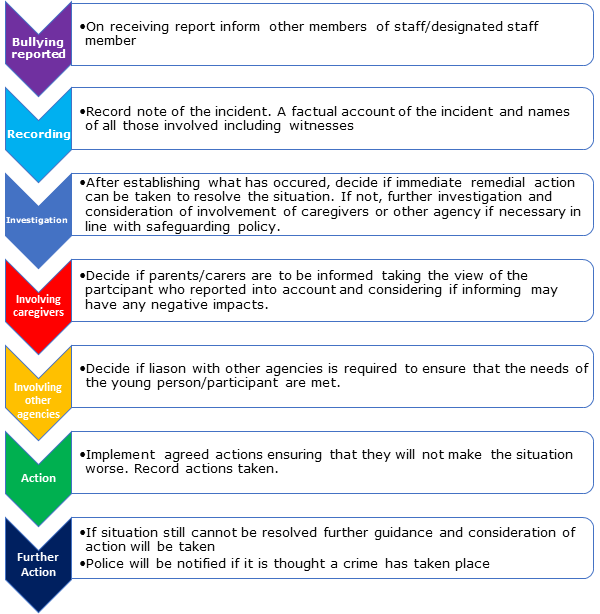
Where the steps outlined above are unsuccessful or inappropriate, the complainant should raise the matter informally and in confidence with IYV Board Chair.
The Board Chair will discuss the matter with the complainant and agree a course of action. The complainant may be accompanied by a parent or other representative at these meetings. The person accused of bullying will also have the right to state their version of events to the Chair and to also be accompanied by parent or other representative.
The complainant must be assured that he/she will not be discriminated against or victimised for raising the complaint. Confidentiality will be observed throughout and the need for any disclosure of the details of the case will be discussed and agreed.